
About
I build the systems around AI that make better decisions possible.
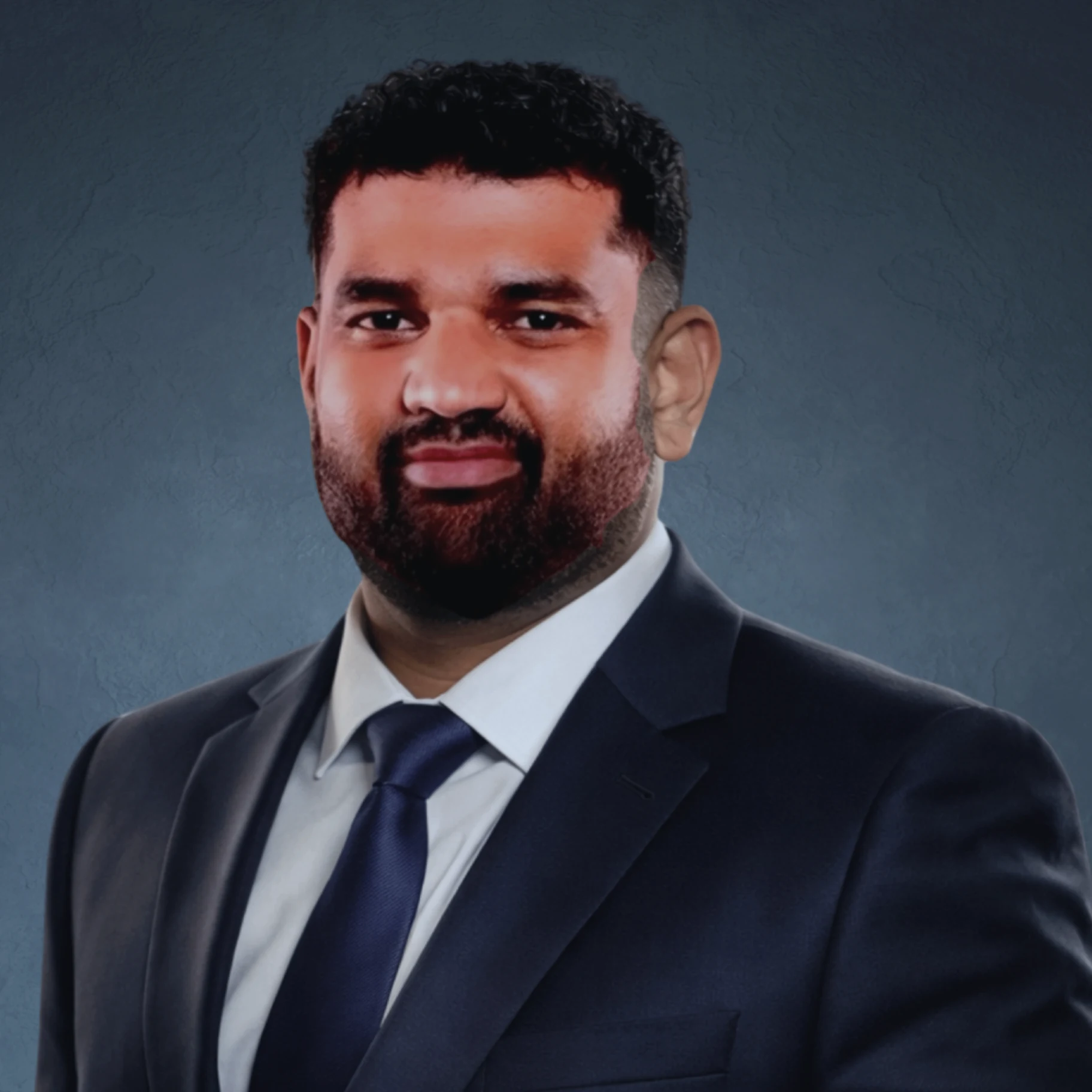
I’m Ahmed Muzammil, a Singapore-based Data & AI leader working at the point where data, AI and human judgement become decisions, workflows and business outcomes.
Vice President, Data Science & Advanced Analytics, Bank of Singapore
At a glance
The short version
- Now
- Vice President, Data Science & Advanced Analytics, Bank of Singapore
- Sectors
- Private banking and wealth management · aviation systems · small-business growth
- Focus
- Governed AI and agents · decision systems · customer intelligence · AI adoption and operating models
- Hands-on
- Python, SQL and PL/SQL · ML and LLM workflows · data pipelines and DataOps · CI/CD
- Frameworks
- PINPOINT · BLUEPRINT · EVOLVE · The Fractal Leader · Business Maximizer®
- Recognition
- Visionary Leader to Watch in AI and in Fintech, Traicon (2026) · Top Trainer Award (2024, 2025)
- Next talk
- Keynote, Singapore Agentic AI Forum, 24 February 2027
Organising an event or writing about this work? The bio and press kit has short, medium and long bios, a career timeline and a headshot.
01. What I work on
I’ve spent more than 15 years building technology, analytics, and intelligent systems.
Today, I serve as Vice President, Data Science & Advanced Analytics at Bank of Singapore, where I lead a team working on data science, advanced analytics, and applied AI in private banking.
My work sits at the intersection of technology, business, and human judgement.
Over the years, I’ve built systems that help people understand information, recognise opportunities, identify risks, and make more informed decisions.
But the more I work with data and AI, the more I realise that building sophisticated technology is only one part of the challenge.
The harder part is making it useful.
An AI model can produce an impressive answer. But can it help someone make a better decision?
Can it operate responsibly within a regulated organisation?
Can people trust it, understand its limitations, and recognise when it gets something wrong?
And can we build the organisational capability to turn that intelligence into meaningful business outcomes?
These are the questions behind my work on enterprise AI, decision systems, customer intelligence, analytics, governed agents, adoption and leadership.
I believe the real opportunity with AI is not simply to build more intelligent machines. It is to build organisations that can make better decisions, serve people better, and use intelligence responsibly at scale.
02. How I got here
The boy from Thuckalay
I grew up in Thuckalay, a small town near the southern tip of India, in a district where three seas meet.
My earliest introduction to technology came from my father.
He worked as a system administrator at Sony in Saudi Arabia. When I was growing up, he would bring home old keyboards, computer mice, and electronic parts for me to experiment with.
Other kids had toys. I had computer parts.
By the time I was twelve, he had taught me HTML, and I had built my first website. At fourteen, I was charging neighbours four hundred rupees to reinstall Windows on their computers.
My first paying client was my brother-in-law, who asked me to design an advertisement for the family business. Soon I was creating brochures, wedding cards, business cards, websites, and animated banners.
If somebody had a problem and I could figure out how to solve it with technology, I wanted to give it a try. I didn’t simply enjoy computers. I enjoyed understanding how things worked, finding a better way, and building something that could make another person’s life a little easier. That curiosity has stayed with me.
03. Career journey
Most of the doors I thought were closed were actually just heavy.
After completing my engineering degree, I joined Tata Consultancy Services and worked on a project for Singapore Airlines.
A few years later, an opportunity came up for a Singapore-based role.
I wanted it.
But I was rejected. Twice.
I was short of the specific technology experience the team needed. Rather than treating that as the end of the conversation, I went back to the interviewer with a different proposition.
Give me a project. Any specification. I’ll build it and show you what I can do.
Two weeks later, I had the offer.
A week after that, I was on a plane to Singapore.
That experience taught me something I have carried throughout my career. Most of the doors I thought were closed were actually just heavy.
Sometimes, the answer is not to ask for another opportunity. It is to demonstrate what you can do with the opportunity in front of you.
Singapore became home, and my professional journey continued from that Singapore Airlines programme to Bank Julius Baer, a company of my own, and Bank of Singapore.
Each experience introduced me to more complex systems, higher expectations, and decisions with greater consequences. And each one changed the way I thought about technology.
04. Why decisions became the centre
From building technology to building intelligence
Over the years, my work has evolved from building software and data systems to building intelligence that supports real business decisions.
Regulated, relationship-led financial services, and private banking in particular, became one of my main proving grounds. The business runs on information, relationships, trust, and judgement.
A relationship manager needs to understand a client’s financial position, investment behaviour, changing circumstances, preferences, and long-term goals.
But the information required to understand that relationship is often spread across different systems, records, and interactions.
A dashboard might tell you that a client holds five million dollars in assets. It doesn’t necessarily tell you whether that relationship is strengthening, whether the client’s needs have changed, or whether an important conversation is being missed.
That is where my work in client intelligence, predictive analytics, and AI comes in.
I have worked on solutions that use client behaviour, relationship information, and analytical models to help bankers identify meaningful changes and make more informed decisions.
From RFM segmentation and Customer Lifetime Value to predictive analytics and AI-assisted workflows, the objective has been consistent. Help people recognise what matters, understand the context, and decide what to do next.
But the more I worked on these systems, the more I understood that a technically accurate recommendation is not necessarily the right recommendation for a particular person.
A client who hasn’t traded in six months might be disengaging. Or they might be perfectly satisfied with a long-term investment strategy.
The model identifies a signal. Human context and judgement determine what that signal means.
The purpose of AI is not to replace the relationship. It is to help the people responsible for that relationship understand it more deeply.
That distinction has become central to how I approach applied AI.
05. What AI changed
The hardest part of AI is often the system around the AI.
Building an AI system that works in a demonstration is one thing. Making it work reliably inside a real organisation is something else entirely.
I have spent years working in environments where information is sensitive, regulations matter, and decisions have consequences.
In those environments, an impressive model is not enough.
You need the system around it: how an agent connects to an existing workflow, what it is permitted to know and do, which controls apply, what it costs to run, how people adopt it, and who remains accountable when intelligence becomes action.
You need to consider data quality, privacy, security, compliance, operational controls, and the people who will ultimately use the technology.
And you need to understand the economics.
A system that works technically but costs more to operate than the value it creates is not a sustainable solution.
A system that produces excellent insights but never becomes part of someone’s working day is not delivering its full potential.
A system that performs well overall but fails in important individual situations deserves closer examination.
The questions I find myself asking increasingly go beyond what a model can do.
What business problem are we actually trying to solve?
Where should we invest?
Which decisions should AI support, and which should remain with people?
What controls are needed?
How will we know whether the system is creating value?
And how do we help people become confident enough to use these capabilities responsibly?
These are not questions that technology teams can answer alone. They require business leaders, technologists, risk and compliance professionals, and the people doing the actual work to come together.
AI becomes valuable when technology, business processes, governance, and human judgement work as one system.
06. Learning to see the whole system
From solving individual problems to understanding the whole system
Alongside my corporate career, entrepreneurship has been part of how I learn systems. At Growth Bamboo I learned that improving one part of a business does not fix the whole. Leads, conversion, retention, and founder dependency are connected.
Business Maximizer® is one expression of that lens. It is an original systems framework for understanding where value is created, where friction sits, what constrains growth and where intervention creates leverage. I still use it when evaluating AI, automation and agent opportunities: start with the business system and the decision, not the technology.
That same systems lens now shapes how I approach enterprise AI. Strategy, governance, adoption, and operating model have to work together, or the technology does not stick.
07. Decision thinking
What will I do differently now that I can see it?
One of the ideas that has shaped my thinking is what I call the Fractal Lens.
It began with a simple observation.
The overall picture does not always tell you what is happening underneath.
A business can report healthy revenue while individual customer relationships are weakening.
A team can meet its targets while a few people are carrying a disproportionate share of the workload.
An AI model can perform well overall while making poor recommendations for particular groups or situations.
The aggregate tells you something important.
But it is not the entire story.
The Fractal Lens is my way of thinking about what becomes visible when we examine a situation at different levels of detail. It is a decision lens, the same idea I publish as The Fractal Leader.
It starts with three questions.
What does the average hide? Look beyond the summary. Understand the distribution, differences, and individual circumstances behind it.
What happens when I zoom in? Examine the patterns that emerge when you look at individual people, teams, clients, or situations.
Where is trust being built or broken? Understand the human context behind the numbers.
And then comes the decision.
What will I do differently now that I can see it?
I believe effective leadership requires us to move between the overall picture and the individual details deliberately.
The data gives us structure. Human judgement gives us context.
Together, they help us make better decisions.
Zoom out to see the system. Zoom in to see what matters. And never confuse the summary with the whole story.
08. Leadership and teaching
My greatest satisfaction is seeing other people grow.
One of the most rewarding parts of my work has been helping people discover that they are capable of more than they initially believed.
I’ve had the opportunity to lead teams, develop colleagues, share knowledge, and help people become more confident using data and AI.
I enjoy building technology. But I get just as much satisfaction from seeing someone who once found a subject intimidating become confident enough to use it, teach it, or build something of their own.
That is one of the reasons I love teaching.
I’ve developed practical frameworks, conducted workshops, and helped colleagues learn how to use AI in their everyday work.
For me, teaching is not about demonstrating how much you know. It is about making something complicated simple enough that another person can use it.
And leadership follows a similar principle.
You cannot build a lasting organisation if every important decision, every technical problem, and every new idea depends on you. An organisation cannot depend on a few AI specialists if it wants intelligence to become a capability.
I want to help organisations develop the capabilities to use AI responsibly, rather than simply depend on a small group of specialists.
You need to develop people who can think independently, take ownership, and eventually accomplish things you could not have achieved alone.
I want to build teams where people grow beyond the opportunities they initially thought were possible.
Because the real measure of leadership is not simply what you achieve. It is also what becomes possible for others because you were there.
09. What I’m building toward
Building the next generation of intelligent organisations
When I look at the future of AI, I see an opportunity that goes far beyond chatbots, individual models, or automating isolated tasks.
I see organisations learning to use intelligence differently. Organisations where information is connected, where AI supports better decisions, and where people can focus more of their time on meaningful work.
But getting there requires more than technology.
It requires a clear business strategy, thoughtful investment, responsible governance, capable teams, and a willingness to rethink how work gets done.
These are the areas in which I want to continue growing as a leader.
My ambition is to help shape the AI strategy and operating models of organisations at an enterprise level, bringing together business value, technology, governance, and people.
I am building toward enterprise AI leadership: strategy, industrialisation, and governance for relationship-led financial services.
I want to build intelligent systems that earn trust through the value they create and the way they are governed.
And I want to build and develop teams capable of turning ambitious ideas into systems that work in the real world.
I want to help build organisations where data and intelligence improve real decisions, where AI is embedded into useful workflows, where controls enable rather than merely restrict action and where people remain accountable for the outcomes that matter.
That is the leadership territory I am building toward: enterprise AI, decision systems, adoption, governance and the operating models that make intelligence useful at scale.
10. Beyond the day job
Building value. Helping others grow.
Outside my corporate role, I write, teach, mentor, experiment, and build in the open.
My work includes the Fractal Lens, Business Maximizer®, and practical frameworks for working with AI. Kognita is the open-source piece, and it is an alpha: proving an AI answer was permitted, and evidencing how it was produced.
I enjoy connecting ideas across disciplines, particularly when something learned in one field can help solve a problem in another.
I also enjoy speaking about the practical side of AI: what works, what doesn’t, and what it takes to move from interesting technology to meaningful outcomes.
But beyond the technology, the thing that matters most to me is the impact we have on other people.
The people we help. The opportunities we create. The knowledge we share. And the people who become more capable because we chose to give something of ourselves.
I want my work to create value beyond the systems I build or the organisations I work for. I want it to create opportunities for others.
Build value. Inspire growth. Lead with purpose. That’s the work I want to keep doing.
And the kind of leader I want to keep becoming.
Let’s Connect
Meaningful conversations about AI, data, leadership, and responsible innovation.
I’m always open to meaningful conversations about applied AI, data, leadership, responsible innovation, and the future of intelligent organisations.
If you’re working on something interesting, looking for a speaker, exploring a collaboration, or simply want to exchange ideas, I’d be glad to connect.
The views and ideas shared on this website are my own and do not necessarily represent those of my employer.